Tuesday, February 23, 2016

FEBRUARY IS AFRICAN AMERICAN HISTORY MONTH - MARY LOU WILLIAMS


   So I admit I watched PBS last night and fell in love with Mary Lou Williams, an incredible jazz pianist and composer and arranger and conductor that we all should know!  That we don't is a testament to sexism and racism rampant in every aspect of our society.  Well, at least now we can begin to shine a light on some of these amazing people.  Thank you PBS.  Thank you Carol Bash!

   Immensely talented as a pianist, Mary Lou Williams was fortunately supported in some of her efforts by a husband who asked that she also be hired to play.  But she suffered the double whammy of being a woman and "dark" skinned at a time when only light skinned women were being hired.
   One of the most unusual facts of the PBS movie was that Mary Lou Williams got a nose job.  Why would she think that she needed that?  So beautiful and so talented -- I know I am being rhetorical by asking this.  But it makes me both furious and flabbergasted to think that she would have had to do this.
   "Mary Lou Williams once said: Jazz is love. You have to lay into and let it flow."

   Mary Lou Williams was born Mary Elfrieda Scruggs in 1910 and died in 1981.  She was raised in Pittsburgh where she played professionally at a very young age.  "Trained by her mother, and aided by her gift of perfect pitch, she was playing professionally by the age of seven."
She joined a group led by John Williams whom she married.   She and her husband joined the Kirk Band, but she was not made a regular until April 1930.  It was Mary Lou Williams' distinctive style that gave the Kirk band its sound.  I am borrowing from the PBS biography -  "She also provided noteworthy swing-band scores for Benny Goodman, Earl Hines, Tommy Dorsey, and others."


   "After leaving Kirk in 1942, Williams formed her own small group in New York with her second husband, Shorty Baker, as trumpeter. She briefly served as staff arranger for Duke Ellington, writing for him the well-knownTrumpet No End in 1946. In the same year, three movements from theZodiac Suite were performed at Carnegie Hall by the New York Philharmonic, a very early instance of the recognition of jazz by a leading symphony orchestra. By now Williams had become an important figure in New York bop, contributing scores to Dizzy Gillespie's big band and advancing the careers of many younger musicians. From 1952 to 1954 she was based in Europe."
   "She retired from music in 1954 to pursue religious and charitable interests, but resumed her career in 1957. She remained active throughout the 1960s and 1970s, leading her own groups in New York clubs, composing sacred works for jazz orchestra and voices, and devoting much of her time to teaching. In 1970, as a solo pianist, and providing her own commentary, she recorded The History of Jazz. Towards the end of her life she received a number of honorary doctorates from American universities, and from 1977 taught on the staff of Duke University."

   "Williams was long regarded as the only significant female musician in jazz, both as an instrumentalist and as a composer, but her achievement is remarkable by any standards. She was an important swing pianist, with a lightly rocking, legato manner based on subtly varied stride and boogie-woogie bass patterns. Yet by constantly exploring and extending her style she retained the status of a modernist for most of her career. She adapted easily in the 1940s to the new bop idiom, and in the 1960s her playing attained a level of complexity and dissonance that rivaled avant-garde jazz pianism of the time, but without losing an underlying blues feeling. A similar breadth may be seen in her work as a composer and arranger, from her expert swing-band scores for Kirk (Walkin' and Swingin', Mary's Idea) to the large-scale sacred works of the 1960s and 1970s. Her Waltz Boogieof 1946 was one of the earliest attempts to adapt jazz to non-duple meters. Among her sacred works are a cantata, Black Christ of the Andes (1963), and three masses, of which the third, Mary Lou's Mass (1970), became well known in a version choreographed by Alvin Ailey."


   She was also the first woman to start her own label - Mary Records - as well as a Music Publishing Company.
   Please see the movie -- you will learn so much much more about this remarkable woman!

Monday, February 22, 2016

FEBRUARY IS AFRICAN AMERICAN HISTORY MONTH -- SEPTIMA POINSETTE CLARK - TEACHER, ORGANIZER, CIVIL RIGHTS LEADER


   Septima Poinsette Clark was born in 1898 and died in 1987.  A teacher and an organizer, she was another key person in the civil rights movement who is little known to the general public.  She taught African Americans citizenship and writing so they could become voting members of society.  She struggled mightily just for her own education, and then later to educate others.  She is known for teaching other civil rights leaders to respect the ordinary people they encountered every day in the struggle.  What was good enough for them had to be good for the people [oh how we need this today!!].


   Here is what the mother of the civil rights movement [Rosa Parks] had to say about Septima Clark:
"Rosa Parks, who has been called the Mother of the Civil Rights Movement, well remembers the first time she met Septima Clark.

It was at a civil rights workshop in Tennessee in the summer of 1955. African-Americans and sympathetic whites had begun to meet quietly, secretly, throughout the South to plan their counterattacks against the segregation system, and to train the new corps of volunteers for that fight. These volunteers would come to be called civil rights workers. Septima Clark, already a 30-year veteran of her people's struggle, was one of the trainers.

   "At that time I was very nervous, very troubled in my mind about the events that were occurring in Montgomery," Rosa Parks says. "But then I had the chance to work with Septima. She was such a calm and dedicated person in the midst of all that danger. I thought, 'If I could only catch some of her spirit.' I wanted to have the courage to accomplish the kinds of things that she had been doing for years." After the sessions with Clark, Parks returned to Montgomery saying she had a firmness and self-confidence she had not felt before. Three months later she refused to give up her seat on a bus so that a white person could sit down, the act which marks the beginning of the modern civil rights movement."

   "She was born in Charleston, South Carolina, in 1898, and until the end of her life you could tell it from her accent; never loud...always patient and firm. Single mother, public school teacher, quietly devout Christian, she began organizing anti-racist activities in the Deep South in the 1920's. She stuck through the Movement in its most difficult moments: dark nights of fear on lonely back highways...the bombing and burning of churches and meeting halls...the beatings and murders of friends and co-workers. She volunteered to work in the most dangerous spots, surviving jail and two heart attacks in the process. And she lived to witness the Movement's greatest triumphs: the end of segregated public facilities...the passage of the great civil rights legislation of the 1960's...the election of African-American public officials in the South for the first time in a hundred years."

   "This remarkable woman accomplished a lot during her lifetime. Although her principal and teachers recommended that she go to college when she was 18, her parents did not have the means to send her. However, she was determined to get a college education.

   "In 1930, at the age of 32, Septima Clark began taking summer classes at Columbia University in New York City. She began these classes primarily because she felt she was not getting the results she expected from the children she was teaching in South Carolina. Seven years later she continued at Atlanta University in Georgia where she took more courses, including one taught by W.E.B. DuBois. She persevered in her pursuit of her Bachelor's degree and finally in 1942 was awarded her degree from Benedict College. She did not stop there, however, and three years later she went on to receive a Master's degree from Hampton Institute --- at the age of 47."  (www.sistermentors.org)  

"Shortly before she sent Rosa Parks back to Montgomery and into the history books, Septima had been fired from her job with the South Carolina public schools when she refused to quit the local chapter of the NAACP. She had been an NAACP member since 1919, almost from the date of its inception.
   "At the age of 58 and following 40 years as a public school teacher, the thought of retirement simply never seems to have entered her mind. She took a job as Director of Education at the Highlander Center in Tennessee, which had long been active in the Southern struggles for unionization and racial equality. The Center was often accused by Southern segregationists of being run by Communists.
   "Septima discounted the red-baiting, saying "that was the general feeling you got in those days whenever the races mixed." Still, becoming a full-time civil rights worker was an immense leap in the dark for her. "For three long months I couldn't sleep," she recalled about the period following her arrival at Highlander. "Then at the end of that time it seemed to me as if my mind cleared up, and I decided then that I must have been right."


   "An army of civil rights workers spread out across South, sitting in at lunch counters, marching in the face of police dogs and riot sticks, registering the disenfranchised. They were volatile, volcanic meteors that streaked across the Southern skies and changed a way of life forever. Some saw their contribution in thundering, inspirational speeches...some were quiet pilgrims making witness to their faiths in jail cells. Septima, the lifelong teacher, figured she'd set up a few schools to show her people how to take advantage of the new rights that were being opened up to them.

"I just tried to create a little chaos," Septima said, explaining her role. "Chaos is a good thing. God created the whole world out of it. Change is what comes of it."

   "One area that needed changing most was the area of voting rights for African-Americans in the South. Legally, Black Southerners had the right to vote. However, most were kept from the polls by the various state "literacy tests." Prospective voters were asked to read and then "interpret" a section of the state or national constitutions. The products of inferior, segregated school systems, many adult Blacks could barely read or write their own names. Most did not even bother to try to register.

   "First through the Highlander Center and later through Martin Luther King's Southern Christian Leadership Conference, Septima organized a series of citizenship schools across the South to train local leaders in such skills as how to teach reading and writing and how to pass the literacy tests. The results were revolutionary.

"One of the fellows we were teaching in Alabama went up to the bank in his little home town to cash a check," Septima said. "The white man took out his pen and said, 'I'll make the X.' And the Black fellow said, 'You don't have to make the X for me, because I can write my own name.' The white guy says, 'My God, them niggers done learned to write!'

"At the time, people thought I had new-fangled ideas, but I guess those new-fangled ideas worked out, didn't they?"

   Septima Poinsette Clark left a deep impression on all that knew her. She was a gracious and excellent teacher, mentor, civil rights worker.  There would likely have been a less successful movement if she had not been part of it.     
[My thanks to J. Douglas Allen-Taylor for his excellent article about Septima Clark.  It should be published!!!]


Biography.com -- http://www.biography.com/people/septima-poinsette-clark-38174 
Black past - http://www.blackpast.org/aah/clark-septima-poinsette-1898-1987 
African American Registry - http://www.aaregistry.org/historic_events/view/septima-p-clark-south-carolina-educator-and-civil-rights-activist 
Encyclopedia Britannica - http://www.britannica.com/biography/Septima-Poinsette-Clark 
North Carolina Humanities Council - http://nchumanities.org/programs/road-scholars/septima-clark-citizenship-education-and-women-civil-rights-movement 
Unpublished article by Douglas Allen Taylor - http://www.safero.org/articles/septima.html 
MLKing Encyclopedia - http://kingencyclopedia.stanford.edu/encyclopedia/encyclopedia/enc_clark_septima_1898_1987/   
Sister Mentors -- http://www.sistermentors.org/dcmarch03.htm   

Sunday, February 21, 2016

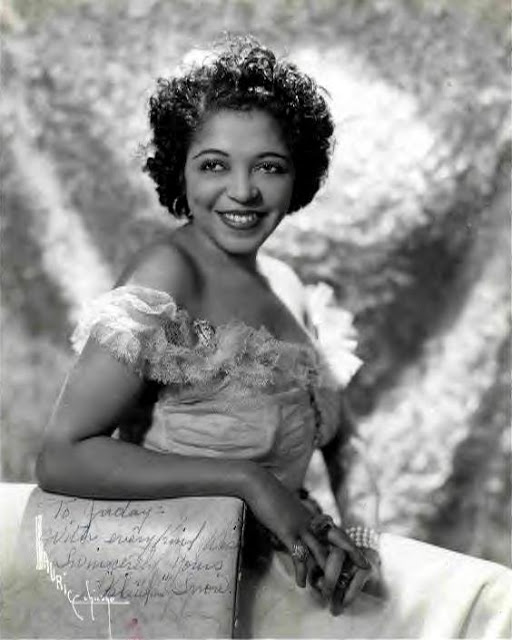
FEBRUARY IS AFRICAN AMERICAN HISTORY MONTH - VALAIDA SNOW


  Virtually unknown in the United States, Valaida Snow may be the most talented performer you have never heard of before.  I learned about her from my fellow teacher and excellent filmmaker Alile Larkin, who wrote and illustrated a beautiful children's book about her.  There is much controversy surrounding her own accounts of her experience when she went abroad and was caught by the Nazis while living in Denmark.
   Valaida Snow learned to perform from her show business parents.  She was born in 1904 in Chattanooga, Tennessee into a large family.  By age 5 she was singing and dancing,  and playing the violin.  By age 15 she could play the violin, cello, bass, banjo, mandolin, harp, accordion, clarinet, saxophone, and trumpet.  "She also sang and danced. Her preferred instrument was the trumpet, and she soon acquired the nickname, “Little Louis,” from Louis Armstrong himself who acknowledged her greatness—he told others she was the second best jazz trumpet player alive."


      Valaida Snow was as beautiful as she was talented. She conducted all male orchestras. She was an excellent trumpeter in a male profession.  She was a singer, dancer, performer and sought after for various shows including  "Broadway and nightclub acts. She was cast in Noble Sissle and Eubie Blake's Chocolate Dandies in 1924. Chocolate Dandies toured for six months and made it to Broadway. Lena Horne and Josephine Baker were among the chorus girls for this exciting production. Snow performed in concerts in the states, Europe and Asia. (memorylane.com.uk)"    "Valaida's heyday was in the 1930s, when she was a celebrity in London and Paris. Her signature hit song "High Hat, Trumpet, and Rhythm" was recorded during this time. Snow was in Rhapsody in Black with Ethel Waters in New York. She even appeared in films and her popularity showed no signs of diminishing. A successful run at the Apollo Theater in New York and a high profile marriage to Ananias Berry, one of the dancing Berry Brothers, did not hurt either. (jazz.com)"


   "Indeed, Valaida Snow had an impressive discography of music and appearances. She made significant contributions in the male dominated music industry as a Black female. Snow traveled to all the major cosmopolitan cities by the time she was twenty five and conducted orchestras at age thirty, according to Mark Miller*. The Queen of the Trumpet also led all female jazz bands, proving that she could pack dance halls and auditoriums. Yes, she was more than just a pretty colored chorus girl doing the latest dance craze in a Harlem nightclub."


   "In the mid-1930’s she made films with her husband, Ananias Berry, of the Berry Brothers dancing troupe. After playing New York’s Apollo Theatre, she revisited Europe and the Far East for more shows and films."   Click on this link to see her husband performing:
https://www.youtube.com/watch?v=ue7wVVRqWpc     The Berry Brothers Dance Act


   "As the story has been written numerous times, while touring through Denmark in 1941, she was arrested by the Nazis during the German occupation of Denmark and kept at Vestre Fængsel (Western Prison), a Danish prison in Copenhagen that was run by the Nazis. She was released on a prisoner exchange in May 1942. According to jazz historian Scott Yanow, “she never emotionally recovered from the experience.”
   This account is highly disputed.  "Author and researcher Jayna Brown in her book Babylon Girls: Black Women Performers and the Shaping of the Modern claims that Snow stayed in wartime Denmark by choice and that the story of her imprisonment was a press generating ploy invented by her management to set the stage for her return to America. Mark Miller’s biography High Hat, Trumpet and Rhythm: The Life of Valaida Snow also dismantles the fictions of her life and paints a portrait of a talented performer, albeit one that didn’t shy from stretching the truth to suit her needs for a bit of play in the press."


   "Her unmatched musicianship in the early part of the twentieth century in the field of vaudeville, jazz and film cannot be denied. The "Queen of Trumpet" excelled in a male dominated arena. She was a jazz performer who was in Denmark at the time of Nazi occupation during WWII. Valaida Snow's shocking claim of being in a Nazi concentration camp and her life as an entertainer warrants a closer look. Snow died of cerebral hemorrhage in 1956."
    "While the truth of her stories of imprisonment may be in question, what is undeniably true is that Ms. Snow was an entertainer extraordinaire; a Black woman from the U.S.A. who, against the odds, survived in Europe during the Nazi era!"


Valaida Snow, The Real Queen of Jazz - http://www.angelfire.com/jazz/ninamaemckinney/ValaidaSnow.html 
America Comes Alive - Valaida Snow: Jazz Pioneer and Queen of the Trumpet - http://americacomesalive.com/2014/03/11/valaida-snow-1904-1956-jazz-pioneer-queen-trumpet/#.VskkkEvoZo4 
Montford Point Marines - Valaida Snow - http://montfordpointmarinesandhonor.blogspot.com/2014/03/valaida-snow-african-american-woman-in.html 
Black History Month - Valaida Snow - http://afrogermans.us/black-history-month-valaida-snow/   

Friday, February 19, 2016

FEBRUARY IS AFRICAN AMERICAN HISTORY MONTH -- ROBERT PARRIS MOSES


   Probably one of the lesser known greats of the civil rights movement, Robert Parris Moses is known lately as an educator and founder of The Algebra Project.  Possibly the most down-to-earth brilliantly educated organizer of the struggle, he recognized the potential of every person as he organized for voting rights in Mississippi.  He encouraged people such as Fannie Lou Hamer to take leadership, rather than putting himself forward.   It was Bob Moses who came up with the idea for the Freedom Summer project inviting northern college students down to organize for voting rights in 1963.  Bob Moses also thought up the Mississippi Freedom Democratic Party, led by Fannie Lou Hamer, to challenge the racism of the Democratic Party in 1964.  And so much more.


   Precisely because he was so intelligent and yet so modest, his influence was great.  Born in Harlem in 1935, he attended public schools, Stuyvesant High School, and then a scholarship to Hamilton College in Clinton, New York.  He earned a Masters Degree from Harvard University.  He was working toward a Doctorate when his mother died and his father became ill, so he returned to New York and became a school teacher at Horace Mann School.
   When he finally stepped down from his role in the civil rights movement, he returned to New York and organized against the war in Vietnam.   "Throughout his involvement in the civil rights movement Moses was subject to physical violence. He was arrested numerous times in Mississippi. In 1966, Moses, a conscientious objector to the Vietnam War, fled to Canada to escape the draft. Two years later he moved to Tanzania and taught mathematics. Upon his return to the United States in 1976, Moses resumed his undergraduate studies at Harvard which he had left in 1957."
- See more at: http://www.blackpast.org/aah/moses-robert-p-1935#sthash.NcdNlHff.dpuf  


   From Americans Who Tell The Truth website:  "In a 2013 interview, the historian Taylor Branch explained Robert Parris Moses’s significance to the American Civil Rights Movement: "To this day he is a startling paradox," Branch said. "I think his influence is almost on par with Martin Luther King, and yet he's almost totally unknown." Through his years as a Civil Rights organizer, Moses was self-effacing, observant and sensitive. These characteristics kept him out of the spotlight, but made for a highly effective leader."

   "For this work, Moses was awarded the MacArthur "Genius Grant" in 1982. Not content to rest after past achievements, Moses moved forward with a new civil rights agenda: education. He used the MacArthur grant to start The Algebra Project (AP), which helps the lowest-performing students prepare for college math and twenty-first century careers."

   “AP’s unique approach to school reform intentionally develops sustainable, student-centered models by building coalitions of stakeholders within the local communities, particularly the historically underserved population. Since 2000, we have continued to provide the context in which students, schools, parents and communities maximize local resources and take ownership of their own community building and mathematics education reform efforts.”
   "In 2001, Moses published a book, Radical Equations: Civil Rights from Mississippi to the Algebra Project. There he explains how the principles of the Civil Rights Movement can be applied to the fight for equitable public education. "Everyone said sharecroppers didn't want to vote. It wasn't until we got them demanding to vote that we got attention. Today, when kids are falling wholesale through the cracks, people say they don't want to learn. We have to get the kids themselves to demand what everyone says they don't want.” In the book, Moses explains how community involvement is the key to successfully changing schools and communities for the better."


   "In addition to the MacArthur Fellowship, Moses has received several awards for his work, including the War Resisters League Peace Award (1997), Heinz Award for the Human Condition (2000), Puffin/Nation Prize for Creative Citizenship (2001), Margaret Chase Smith American Democracy Award (2002), James Bryant Conant Award (2002) and Alphonse Fletcher, Sr. Fellowship (2005). At an age where most are retired, Moses continues teaching in Algebra Project schools and traveling, sharing his model for community-building and improving education all over the United States."


“Well, I don’t think that the Democratic Party to this day has confronted the issue of bringing into its ranks the kind of people that were represented by the Mississippi Freedom Democratic Party. That is the real underclass of this country. The Democratic Party primarily has organized around the middle class. And we were challenging them not only on racial grounds but we were challenging them on the existence of a whole group of people who are the underclass of this country, white and black, who are not represented. And they weren’t prepared to hear that; I don’t know if they heard.” — Bob Moses, quote on portrait

Civil Rights Digital Library - http://crdl.usg.edu/people/m/moses_robert_parris/?Welcome 
King Encyclopedia - http://kingencyclopedia.stanford.edu/encyclopedia/encyclopedia/enc_moses_robert_parris_1935/  
Americans Who Tell the Truth - http://www.americanswhotellthetruth.org/portraits/bob-moses 
Black Past - http://www.blackpast.org/aah/moses-robert-p-1935 
American Radio Works - Say It Plain, Say It Loud http://americanradioworks.publicradio.org/features/blackspeech/bmoses.html  Robert Moses Speech on Freedom Summer.
Mississippi Freedom Summer 50 Years - http://freedom50.org/moses/   
Zinn Education Project - http://zinnedproject.org/materials/robert-moses/ 

Readings (from American Radio Works - see above)
1. Robert P. Moses, Radical Equations — Civil Rights from Mississippi to the Algebra Project (Boston: Beacon Press, 2001), 3.
2. Adam Fairclough, Better Day Coming: Blacks and Equality, 1890-2000 (New York: Penguin, 2001), 256-58.
3. Tom Hayden, "Bob Moses: His Technique Is to Be A Catalyst in People's Efforts to Free Themselves," The Nation, July 21, 2003, 34.
4. David Harris quoted by Richard J. Jensen and John C. Hammerback, "Robert Parris Moses," African-American Orators: A Bio-Critical Sourcebook (Westport, CT: Greenwood Press, 1996), 261.
5. Moses, 73.
6. Dudley Lehew, "Mississippi Summer Project to Go On Through Winter," AP report in Sarasota Herald Tribune, August 27, 1964, 14.
7. Moses, 69.
8. John Dittmer, Local People — The Struggle for Civil Rights in Mississippi (Urbana, IL: University of Illinois Press, 1994) 102.
9. Dittmer, 424.

FEBRUARY IS AFRICAN AMERICAN HISTORY MONTH - LENA HORNE

 
   Lena Horne - so many beautiful and talented and complex women have passed through our world.  A load of questions have passed through my mind as I write these short biographies of famous and not so famous African Americans.  Why aren't they better known? How did they manage in such a negative world to project their talent and beauty and leave us all with lasting memories of them? Why didn't they give up in despair?  All of these women were fighters, not just for themselves, but for all African Americans - and therefore, all people.
   Lena Horne was born in 1917 and died in 2010, a long life truly!  Not only was she a talented and beautiful singer and actress, she was also a civil rights activist. How many people knew that about her?   That she refused to accept roles that were stereotypical about African Americans meant that her career was much more difficult for her.  Success while there was not fulfilled.

   Ms Horne became part of a well known white swing band that was one of the first to integrate, yet she had to quit due to the fact that she couldn't stay with them when she traveled.  In 1941 she returned to New York to work at the Cafe Society nightclub, a popular venue for both Black and white patrons and artists.  [My parents told me how they went to see Billie Holiday, Lena Horne, Art Tatum and more.  Billie Holiday debuted her song "Strange Fruit" at Cafe Society. Located at One Sheridan Square, it was opened precisely to give a venue for ordinary people by Barney Josephson, brother of Leon Josephson, a communist friend of my parents.  Most vividly they told me they took their shell-shocked friends who had returned from the Spanish Civil War in order to help them feel better, if possible.]
   Lena Horne's career began to take off -- "A long run at the Savoy-Plaza Hotel nightclub in 1943 gave Horne’s career a boost. She was featured in Life magazine and became the highest-paid black entertainer at the time. After signing a seven-year contract with MGM Studios, she moved to Hollywood, where she filmed movies like Stormy Weather and Cabin in the Sky. Producers quickly realized that she was a difficult woman to cast, however. She could only get limited roles in films with whites, and her light skin made it difficult to cast her alongside popular African-American actors in full-color films. Horne also refused to accept parts that stereotyped African-American women, and she was shunned by the community of black actors."

   Now that we have a President who is half African-American, half white we can perhaps one day talk about the difficulties of "mixed race" people such as Lena Horne.  Generally shunned by both Blacks and whites, their lives were so much more fraught with loneliness and pain.  I will never forget taking my daughter to a movie at the African American Movie Festival in Los Angeles which was basically about how the one mixed-race person was the traitor on the plantation, working in the master's house, having an easier life.  The movie was ground-breaking in many ways - Sankofa - because it openly detailed slavery. But I felt to put the blame on a mixed race person was egregious at the least.

   Lena Horne suffered this type of discrimination - shunned by both sides. "By the end of the 1940s, Horne had sued a variety of restaurants and theaters for discrimination and become an outspoken member of the leftist group Progressive Citizens of America with Paul Robeson. McCarthyism was sweeping through Hollywood, and Horne soon found herself blacklisted. Since she was unable to work in film, television, theater or recording, she performed primarily in posh nightclubs around the country. The ban eased in the mid-1950s, and Horne returned to the screen in the 1956 comedy Meet Me in Las Vegas."   She was still active in the civil rights movement despite being blacklisted.  She participated in the March on Washington in 1963.


   From the NY Times Obituary -
“The whole thing that made me a star was the war,” Ms. Horne said in the 1990 interview. “Of course the black guys couldn’t put Betty Grable’s picture in their footlockers. But they could put mine.”

"Touring Army camps for the U.S.O., Ms. Horne was outspoken in her criticism of the way black soldiers were treated. “So the U.S.O. got mad,” she recalled. “And they said, ‘You’re not going to be allowed to go anyplace anymore under our auspices.’ So from then on I was labeled a bad little Red girl.”

   In 1970 and 1971 Lena Horne's son, husband, and father all died and she spent much time in mourning. "Horne made her final film appearance in the 1978 movie The Wiz. The film was a version of The Wizard of Oz that featured an entirely African-American cast including Michael Jackson and Diana Ross, and Horne played Glinda the Good Witch."  She made a triumphant return to Broadway in a one-woman show for which she won a Drama Desk Award, a Tony, and two Grammy Awards for soundtrack.
   "In 1994 Horne gave one of her last concerts, at New York’s Supper Club. The performance was recorded and was released in 1995 as An Evening With Lena Horne: Live at the Supper Club, which won a Grammy for Best Jazz Vocal Album. Though she contributed occasional recordings after this, she largely retreated from public life."
   "Lena Horne died of heart failure on May 9, 2010, in New York City."

   As IMDB states in its biography of Lena Horne - "Had it not been for the prevailing racial attitudes during the time when Lena was just starting her career, it's fair to say that it would have been much bigger, and come much sooner, than it was. Even taking those factors into account, Lena Horne is still one of the most respected, talented and beautiful performers of all time--and she's still singing!"
   From Notable biographies  - "In the 1990s Horne cut back on performing. She was drawn back from semiretirement to do a tribute concert for a long-time friend, composer Billy Strayhorn, at the JVC Jazz Festival. At age seventy-six she released her first album in a decade, We'll Be Together Again. In 1997, on the occasion of her eightieth birthday, Horne was honored at the JVC Jazz Festival with a tribute concert and the Ella Award for Lifetime Achievement in Vocal Artistry. In 1999 she was honored at the New York City's Avery Fisher Hall with an all-star salute."
   "Lena Horne is an amazing woman. Her pride in her heritage, her refusal to compromise herself, and her innate elegance, grace, and dignity has made her a legendary figure. Her role as a person who has helped to improve the status of African Americans in the performing arts has provided a permanent legacy."
Read more: http://www.notablebiographies.com/Ho-Jo/Horne-Lena.html#ixzz40d6ejtco


Lena Horne Biography - http://www.biography.com/people/lena-horne-9344086 
Ephemeral Cafe Society - https://ephemeralnewyork.wordpress.com/tag/cafe-society-1930s/  
IMDB lists 55 soundtracks - http://www.imdb.com/name/nm0395043/ 
IMDB biography - http://www.imdb.com/name/nm0395043/bio 
Notable biographies - http://www.notablebiographies.com/Ho-Jo/Horne-Lena.html 
NY Times Obituary - http://www.nytimes.com/2010/05/10/arts/music/10horne.html?pagewanted=all&_r=0 

Books:
Buckley, Gail Lumet. The Hornes: An American Family. New York: Knopf, 1986.

Haskins, James, and Kathleen Benson. Lena: A Biography of Lena Horne. Chelsea, MI: Scarborough House, 1991.

Palmer, Leslie. Lena Horne: Entertainer. New York: Chelsea House Publishers, 1989.


Read more: http://www.notablebiographies.com/Ho-Jo/Horne-Lena.html#ixzz40dOoiHsM

Thursday, February 18, 2016

FEBRUARY IS AFRICAN AMERICAN HISTORY MONTH -- NINA SIMONE


   Nina Simone was born in 1933 and died in 2003.  Her mother was a minister and Nina played her first tune on the church organ by age 8.   By age 10 she was the church organist.  She was born in Tyron, North Carolina and her name was Eunice Waymon.  Although she had a scholarship raised by local patrons, she was denied admission to the Curtis Institute of Music in Philadelphia.  So she turned to singing in clubs, and in 1959 recorded a hit "I Loves You Porgy".  She took the professional name of Nina Simone.

   Nina Simone was a singer, a pianist (she could've been a concert pianist without US apartheid), a civil rights activist, and much more.   Born February 21st - she shares the month - 1933, she did study at Juilliard to study classical piano but left early due to lack of money.  [Biography.com http://www.biography.com/people/nina-simone-9484532  differs from other information a bit.)   She turned to jazz, blues, and folk music and performed in clubs.  In the 1960s she was identified as a voice of the civil rights movement.

   "In many ways, Simone's music defied standard definitions. Her classical training showed through, no matter what genre of song she played, and she drew from many sources including gospel, pop and folk. She was often called the "High Priestess of Soul," but she hated that nickname. She didn't like the label of "jazz singer", either. "If I had to be called something, it should have been a folk singer because there was more folk and blues than jazz in my playing," she later wrote."
   "By the mid-1960s, Simone became known as the voice of the civil rights movement. She wrote "Mississippi Goddam" in response to the 1963 assassination of Medgar Evers and the Birmingham church bombing that killed four young African-American girls. After the assassination of Reverend Martin Luther King Jr. in 1968, Simone penned "Why (The King of Love Is Dead)." She also wrote "Young, Gifted and Black," borrowing the title of a play by Hansberry, which became a popular anthem at the time."
   

  "As the 1960s drew to a close, Simone tired of the American music scene and the country's deeply divided racial politics. She lived in several different countries, including Liberia, Switzerland, England and Barbados before eventually settling down in the South of France. For years, Simone also struggled with her finances, and clashed with managers, record labels, and the Internal Revenue Service."

"Around this time, Simone recorded cover songs of popular music, putting her own spin on such songs as Bob Dylan's "The Times They Are A-Changin'" and the Beatles' "Here Comes the Sun." She also showed her sensual side with the song "I Want a Little Sugar in My Bowl." She then took a break from recording, returning in 1978 with the album Baltimore. The title track was a cover version of a Randy Newman song. Critics gave the album a warm reception, but it did not do well commercially."
   "Simone went through a career renaissance in the late 1980s when her song "My Baby Just Cares For Me" was used in a perfume commercial in the United Kingdom. The song became a Top 10 hit in Britain. She also penned her autobiography, I Put a Spell on You, which was published in 1992. Her next recording, A Single Woman, came out in 1993. To support these works, Simone gave some performances in the United States."


   "Touring periodically, Simone maintained a strong fan base that filled concert halls whenever she performed. She appeared in New York City in 1998, her first trip there in five years. The New York Times critic Jon Pareles reviewed the concert, saying that "there is still power in her voice" and the show featured "a beloved sound, a celebrated personality, and a repertory that magnifies them both."        "That same year, Simone attended South African leader Nelson Mandela's 80th birthday celebration."
In her final years, Nina Simone battled with health problems. Some reports indicate she was battling breast cancer, but that claim has not been officially confirmed. She died on April 21, 2003, at her home in Carry-le-Rouet, France."

   "While she may be gone, Simone left a lasting impression on the world of music. She sang to share her truth, and her work still resonates with great emotion and power. Simone has inspired an array of performers, from Aretha Franklin to Joni Mitchell. Her deep, distinctive voice continues to be a popular choice for television and film soundtracks."

    "To me we are the most beautiful creatures in the whole world…Black people. I mean that in every sense."
— Nina Simone

P.S. While I don't know how accurate this is, "I Wish I Knew How It Would Feel To Be Free - The Secret Diary of Nina Simone" by Joe Hagan is much more revelatory and rich about Nina Simone. I hope you'll read it.
   Hagan details some of Simone's struggles with what most likely was bi-polar disorder. She wanted to be a classical pianist who played Bach, but she made a name as a singer, songwriter and performer of others and her own music, what she would call "folk".  She also was an excellent writer at times. How much better would her life have been had she had access to better therapy and medication? We'll never know.  But her music will always be with us -- I always felt it as the background to my own life.

   In an excerpt, Hagan hits on Simone's possibly bisexuality, as well as need for her strong husband Stroud, a Harlem policeman who also beat her.   "In late 1962, Simone had given birth to her only child, a daughter named Lisa Celeste. Stroud wouldn’t allow Simone to breastfeed the baby, telling her he was jealous. Perhaps inevitably, Simone began spending more time with a woman who would alter her worldview: Lorraine Hansberry, the activist and playwright who wrote A Raisin in the Sun and who authored “The Movement,” the handbook for the Student Nonviolent Coordinating Committee (SNCC). The two spent weekends together at Hansberry’s country home in Westchester County, outside Manhattan, talking for hours about black identity and revolutionary politics, which had held little interest for Simone in the past. “Lorraine carried her over into high gear, put her on fire,” Stroud says. After meeting Hansberry one afternoon, Simone asked him to help locate the basin that fed water to New York City. “Why?” he asked. Because, she declared, “We’ve got to go poison the reservoir!”


Short Bio - http://www.citizen-times.com/story/news/local/2016/02/17/black-history-month-eunice-waymon-aka-nina-simone/80533198/    Asheville Citizen Times
"Official Home" -  http://www.ninasimone.com   Netflix Film - What Happened to Miss Simone? nominated for an Oscar.
Biography.com -- http://www.biography.com/people/nina-simone-9484532 
Nina Simone's Insistent Blackness - http://pitchfork.com/thepitch/849-nina-simones-insistent-blackness/ 
Joe Hagan - The Secret Diary of Nina Simone -- http://longform.org/stories/I-Wish-I-Knew-How-It-Would-Feel-To-Be-Free
Nina Simone's Time Is Now, Again - NY Times - http://www.nytimes.com/2015/06/21/movies/nina-simones-time-is-now-again.html?_r=0  
Facebook page - https://www.facebook.com/nina.simone 
What Happened to Nina Simone?  http://www.theatlantic.com/entertainment/archive/2015/06/nina-simone-and-mississippi-goddam/396923/    DON'T MISS THE VIDEO OF HER SINGING "MISSISSIPPI GODDAMN"     https://www.youtube.com/watch?v=fVQjGGJVSXc#t=56 


Wednesday, February 17, 2016

FEBRUARY IS AFRICAN AMERICAN HISTORY MONTH -- MARY MCLEOD BETHUNE


   While not strictly "unknown" to people in this country, Mary McLeod Bethune was much more than a woman who opened a private school for young African American women in Daytona Florida.  One highlight for me was that she worked for the Roosevelt Administration -- "But she had the most significant influence on Franklin D. Roosevelt's New Deal Government. From 1936-1945 she served as the informal "race leader at large" for the administration. Mrs. Bethune was also one of the most influential African American leaders in the Black Cabinet, which organized the Federal Council on Negro Affairs. She also served as Director of Negro Affairs for the National Youth Administration, where she tirelessly worked to help young people find jobs and to secure funds for youth."   as did my father who knew her well. My father set up the National Youth Administration.  So I feel that she was a family friend, even though I never was able to meet her.  [My father also hired Lyndon Johnson for his first Federal job at the NYA.]


   Mary McLeod Bethune was born in 1875 and died in 1955.  "Equal parts educator, politician, and social visionary, Mary McLeod Bethune was one of the most prominent African American women of the first half of the twentieth century--and one of the most powerful. Known as the "First Lady of the Struggle," she devoted her career to improving the lives of African Americans through education and political and economic empowerment, first through the school she founded, Bethune-Cookman College, later as president of theNational Council of Negro Women, and then as a top black administrator in the Roosevelt administration."  [Eleanor Roosevelt papers project ]  

   A summary of her work in government:   "In 1935, Bethune became a special advisor to President Roosevelt on minority affairs. That same year, she also started up her own civil rights organization, the National Council of Negro Women. Bethune created this organization to represent numerous groups working on critical issues for African-American women. She received another appointment from President Roosevelt the following year. In 1936, she became the director of the Division of Negro Affairs of the National Youth Administration. One of her main concerns in this position was helping young people find job opportunities. In addition to her official role in the Roosevelt administration, Bethune became a trusted friend and adviser to both the president and his wife Eleanor Roosevelt."
   On biography - her role internationally was incredible:  "An early member of the National Association for the Advancement of Colored People, she helped represent the group at the 1945 conference on the founding of the United Nations along with W.E.B. DuBois. In the early 1950s, President Harry Truman appointed her to a committee on national defense and appointed her to serve as an official delegate to a presidential inauguration in Liberia."
   Her influence was far and wide, deep and strong.  "Since her passing, Bethune has been honored in many ways. In 1973, she was inducted into the National Women's Hall of Fame. The U.S. Postal Service issued a stamp with her likeness in 1985. In 1994, the U.S. Park Service bought the former headquarters of the NCNW. The site is now known as the Mary Mcleod Bethune Council House National Historic Site."


Civil Rights Leader - https://ncnw.org/about/bethune.htm   National Council of Negro Women, which she founded.
Mary McLeod Bethune at the Eleanor Roosevelt papers project
 - https://www.gwu.edu/~erpapers/teachinger/glossary/bethune-mary.cfm 
Biography - http://www.biography.com/people/mary-mcleod-bethune-9211266#acclaimed-educator